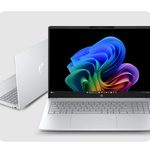
Image Source: HP Official
Who Is It For?
The OmniBook X series consists of thin Windows AI PCs built around soldered LPDDR5X memory, high-TOPS NPUs, and OLED or IPS displays for users who move daily between home, office, and travel while relying on Copilot+ features. Professionals who live in email, documents, video calls, and on-device AI tools, students who carry the machine all day, and remote workers who prefer a light chassis with modern ports fit the daily pattern. Memory capacity is fixed at purchase on most models, storage expansion is limited, and the thin design restricts sustained high loads. Battery life supports mixed work but shortens under continuous high-brightness or multi-app use. If this form factor or power doesn’t quite fit your daily work, exploring other lineup categories would be a better path.
1. Soldered Memory and Thin Chassis Limits
LPDDR5X memory locked at purchase
Memory is soldered LPDDR5X, commonly available in 16 GB or higher configurations depending on the model. No SO-DIMM slots exist on most OmniBook X variants, so capacity is permanent after purchase. Once large numbers of browser tabs, Office files, and AI-assisted apps fill the available memory, there is no later remedy. Confirm the exact installed amount on the sales page.
Storage and expansion options
Storage uses M.2 NVMe SSDs (Gen 4 or Gen 5 on higher models). Some configurations allow replacement; others do not. Primary drives of 512 GB, 1 TB, or 2 TB are common. Verify whether the listed SKU supports drive replacement and the exact capacity.
Port layout and charging
Most models include Thunderbolt / USB4 or USB-C ports with Power Delivery and DisplayPort, plus USB-A, HDMI, and a 3.5 mm jack. Charging relies on USB-C adapters (typically 65–100 W). The thin chassis restricts internal cooling volume, so sustained multi-core loads raise temperatures more quickly than thicker machines. These interfaces and the physical envelope cannot be altered after purchase.
These constraints keep the series oriented toward portable productivity and AI features while locking memory capacity at the point of sale.
2. Daily Carry Weight and Meeting Use
1.3–2.2 kg in a slim bag
Recent OmniBook X models typically weigh between 1.3 kg and 2.2 kg depending on screen size (14-inch or 16-inch). The thin profile disappears into a slim briefcase or backpack. On a café table or airplane tray the footprint leaves reasonable space for a notebook or mouse beside it.
Fan noise and thermal behavior
Air intake occurs on the underside. Under light productivity, video calls, and Copilot use the system stays silent or near-silent. Under sustained multi-core loads the fan becomes audible but remains quieter than most thicker business laptops. Soft surfaces can restrict airflow and raise surface temperatures during longer sessions.
Battery for a full travel day
Battery capacities generally range from about 59 Wh to 70 Wh on smaller models (higher on larger ones). Mixed document work, email, and video calls commonly cover a full workday on a single charge. The compact USB-C charger travels easily for overnight top-ups or continuous high-brightness sessions.
3. Performance by Use Case
Configurations use Intel Core Ultra or Snapdragon processors with integrated graphics and high-TOPS NPUs. All ratings assume typical productivity, AI-assisted, and light creative workloads.
| Use Case | Software | Rating | Reason |
|---|---|---|---|
| Office productivity and video calls | Word, Excel, Teams, Zoom | Sufficient | Modern CPUs and high soldered memory keep concurrent work smooth |
| Copilot+ AI features and multitasking | Windows Copilot, on-device AI tools | Sufficient | High-TOPS NPU accelerates local AI tasks |
| Multi-tab browsing and light photo work | Edge, Photos, basic editing | Sufficient | Dual-channel LPDDR5X sustains browser and media loads |
| Sustained 4K video export or heavy rendering | Premiere, DaVinci Resolve | Not enough | Thin cooling and integrated graphics limit prolonged high loads on most models |
| Native x86-only software without translation (Snapdragon models) | Legacy apps requiring full x86 | Adequate to Not enough | ARM translation works for many apps but not all; check compatibility |
Lower memory configurations reduce the margin on the first three rows. Discrete graphics appear only on select higher-end variants.
4. Official Specs (with plain explanations)
| Category | Specification | Notes |
|---|---|---|
| Display | 14″ or 16″ OLED / IPS, up to 2K/3K | Touch options on some |
| Processor | Intel Core Ultra / Snapdragon | Soldered |
| Graphics | Integrated Intel / Qualcomm; select discrete | Limited options |
| Memory | 16 GB+ LPDDR5X | Soldered; no slots on most |
| Storage | 512 GB–2 TB M.2 | Some replaceable |
| Battery | Approx. 59–70 Wh (smaller models) | Built-in |
| Adapter | 65–100 W USB-C | Compact |
| Weight | 1.3–2.2 kg | Depends on size |
| Ports | Thunderbolt/USB-C, USB-A, HDMI, 3.5 mm | Fixed layout |
This series is sold with different processors, memory, and storage depending on the generation and configuration. Please match the specifications on your current seller page with the official information above.
Source: HP Official Product Page
The soldered memory and thin chassis listed above directly determine long-term capacity limits and daily portability.
5. Main Variations in This Series
Processor choice among Core Ultra or Snapdragon variants changes multi-core headroom, battery efficiency, and native app compatibility. Memory starting at 16 GB versus higher amounts affects how many apps and AI features remain open. Display options between OLED and IPS alter contrast, brightness, and outdoor visibility. Storage of 512 GB versus 1 TB or 2 TB determines how much local data stays onboard. Screen size of 14-inch versus 16-inch changes both weight and desk footprint. Each of these choices is permanent after purchase except for the replaceable M.2 drive where available.
6. What to Check on the Sales Page
Confirm the exact hardware listed for the SKU you are considering, because the same series name covers multiple sizes and processors.
- Exact processor model (Core Ultra or Snapdragon variant).
- Installed LPDDR5X memory amount.
- Primary SSD capacity and whether it is replaceable.
- Display type (OLED or IPS) and size (14″ or 16″).
- Included adapter wattage and exact weight of the configuration.
Matching these five items against the official sheet prevents receiving a lower-capacity or different-size configuration under the same series name.
7. Disclaimer & Buying Advice
This buying guide for the OmniBook X is based on official manufacturer specifications and recurring real-world user experiences. It is completely independent, not sponsored, and does not guarantee specific performance for every unit. Hardware configurations such as the processor, memory, and storage can differ by generation and region, so please double-check the exact specifications listed on your seller’s page before purchasing.
8. Beginner Guide
The fully soldered memory and the thin chassis that limit sustained cooling define the daily limits of this series more than any other factor. Start Here walks through how those constraints interact with common portable productivity, AI-assisted work, and travel patterns before any purchase decision.