
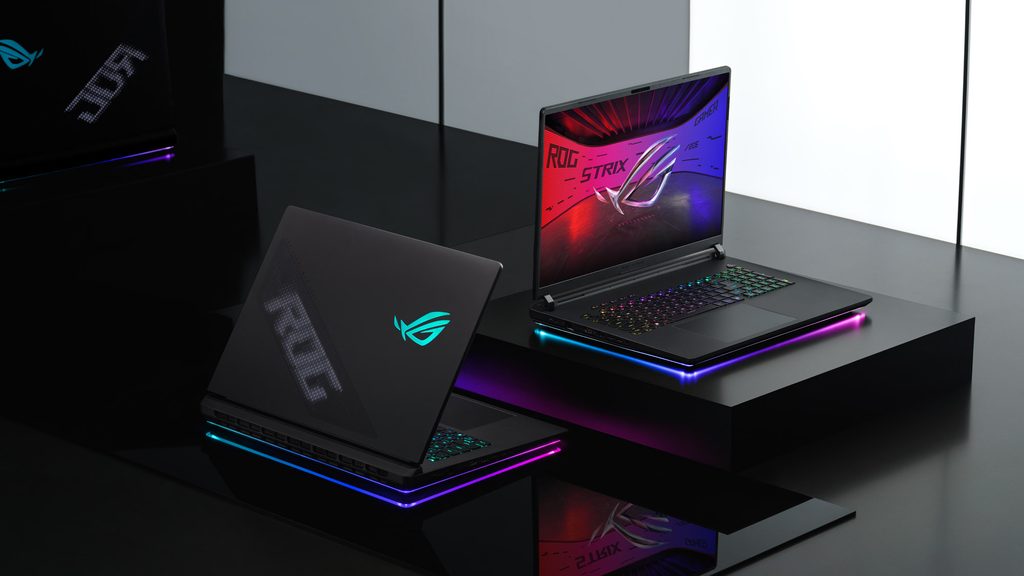
Image Source: ASUS Official
Who Is It For?
The ROG Strix SCAR 18 packs an 18-inch high-refresh display, high-TGP NVIDIA GeForce RTX laptop graphics, and a 90 Wh battery into a 3.7 kg chassis for users who demand desktop-class gaming and creation while still moving between home and temporary locations. Players who want maximum frame rates on a large screen or creators who export long 4K timelines and then pack up for travel fit the daily pattern. The thick body and heavy 380–450 W brick make frequent bag carries less practical than desk-to-desk or hotel-room use. Two SO-DIMM slots and two M.2 bays allow memory and storage expansion after purchase. Battery mode sharply limits the discrete GPU. If this form factor or power doesn’t quite fit your daily work, exploring other lineup categories would be a better path.
1. Extreme TGP Limits and Heavy Brick
GPU power and the required adapter
Graphics options use NVIDIA GeForce RTX 50-series laptop GPUs with TGP up to 175 W (including Dynamic Boost) on flagship configurations. Full sustained performance requires the included 380 W or 450 W proprietary adapter. USB-C Power Delivery is limited and throttles the discrete GPU heavily. The large brick therefore becomes a permanent travel companion for any serious gaming or export session. Confirm the exact GPU model and maximum TGP listed on the sales page.
Dual SO-DIMM memory
Memory uses two DDR5 SO-DIMM slots supporting up to 128 GB. Capacity can be increased later by replacing or adding modules. Confirm the installed amount and that both slots are accessible on the specific model.
Dual M.2 storage and vent design
Two M.2 PCIe slots support the primary SSDs and allow expansion up to high total capacities. Air intake occurs primarily on the underside with exhaust along the rear and sides. Soft surfaces or closed bags quickly restrict cooling and raise temperatures under load. These physical choices remain fixed after purchase except for the modules that fit the slots.
These constraints keep the machine oriented toward plugged-in maximum performance while allowing later memory and storage growth.
2. Daily Carry Weight and Desk Heat
3.7 kg plus the massive brick
The closed chassis measures 39.9 × 29.8 × 2.35–3.50 cm and weighs 3.70–3.73 kg. It fits only large backpacks or dedicated laptop bags. Adding the 380–450 W adapter pushes the total carry weight well past 4.5 kg. Short trips are possible; repeated daily transit across a campus or city becomes fatiguing.
Fan noise and thermal behavior on a desk
Advanced vapor-chamber and multi-fan cooling keeps the system relatively controlled at idle or light work. Under full GPU and high-CPU loads the fans ramp aggressively and become very audible in a quiet room. Rear and underside vents must stay unobstructed; soft beds or thick mats raise surface temperatures quickly. On a hard desk the system sustains its rated TGP, yet the chassis transfers heat to the surface beneath it.
Battery under GPU load
The 90 Wh pack supports a few hours of web browsing, document work, or media playback. Once the discrete GPU engages for gaming or export, runtime drops sharply to a short window. Any serious session still needs the full-wattage adapter nearby.
3. Performance by Use Case
Higher configurations pair Intel Core Ultra HX-series processors with RTX 50-series GPUs at elevated TGP. All heavy GPU work assumes the proprietary high-watt adapter is connected; battery or limited USB-C mode restricts the discrete graphics.
| Use Case | Software | Rating | Reason |
|---|---|---|---|
| Modern AAA gaming at high settings (plugged in) | Cyberpunk, recent titles at 1440p/4K | Sufficient | High TGP and large 240 Hz panel sustain high frame rates when powered |
| Long 4K video editing and export | Premiere, DaVinci Resolve | Sufficient | Discrete GPU, dual M.2, and high memory keep timelines and exports moving on AC power |
| Content creation and heavy multitasking | Photoshop, 3D apps, browsers | Sufficient | Dual SO-DIMM capacity and strong CPU handle concurrent loads |
| Battery-only light productivity | Office, web, streaming | Adequate | 90 Wh pack covers a few hours without GPU load |
| Battery-only gaming or heavy export | Any discrete-GPU intensive task | Not enough | GPU power collapses and runtime shrinks to a short window |
Lower GPU or memory configurations reduce the margin on the first three rows. Sustained maximum TGP is only available with the full adapter.
4. Official Specs (with plain explanations)
| Category | Specification | Notes |
|---|---|---|
| Display | 18″ QHD+ or higher Mini-LED / OLED, 240 Hz | G-Sync; large footprint |
| Processor | Intel Core Ultra 9 HX-series | Soldered |
| Graphics | NVIDIA GeForce RTX 50-series Laptop | Up to 175 W TGP with Dynamic Boost |
| Memory | 2× DDR5 SO-DIMM, up to 128 GB | Upgradable |
| Storage | 2× M.2 NVMe (up to high total capacity) | Upgradable |
| Battery | 90 Wh | Built-in |
| Adapter | 380–450 W proprietary | Full power requires brick |
| Weight | 3.70–3.73 kg | With battery |
| Ports | 2× Thunderbolt 5, HDMI 2.1, 2.5G LAN, USB-A, 3.5 mm | Fixed layout |
This series is sold with different GPUs, memory, and storage depending on the release year and configuration. Please match the specifications on your current seller page with the official information above.
Source: ASUS Official Product Page
The extreme TGP requirement and dual SO-DIMM / M.2 slots listed above directly determine daily adapter use and later expansion.
5. Main Variations in This Series
GPU choice among RTX 5070 Ti, 5080, or 5090 changes sustained frame rates and export times once the machine is plugged in. Memory starting at 32 GB versus 64 GB (expandable to 128 GB) affects how large game worlds or creative projects remain open. Storage of one versus two populated M.2 drives determines how much local game and media libraries stay onboard. Display options between Mini-LED and OLED alter brightness, contrast, and HDR performance. Each of these choices is permanent after purchase except for the modules that fit the available slots.
6. What to Check on the Sales Page
Confirm the exact hardware listed for the SKU you are considering, because the same series name covers multiple GPU and capacity levels.
- Exact GPU model and maximum TGP (including Dynamic Boost).
- Installed DDR5 memory amount and confirmation of two SO-DIMM slots.
- Number of M.2 slots filled and total storage capacity.
- Included adapter wattage (380 W or 450 W).
- Display type (Mini-LED or OLED) and resolution/refresh rate.
Matching these five items against the official sheet prevents receiving a lower-power or lower-capacity configuration under the same series name.
7. Disclaimer & Buying Advice
This buying guide for the ROG Strix SCAR 18 is based on official manufacturer specifications and recurring real-world user experiences. It is completely independent, not sponsored, and does not guarantee specific performance for every unit. Hardware configurations such as the processor, graphics, memory, and storage can differ by generation and region, so please double-check the exact specifications listed on your seller’s page before purchasing.
8. Beginner Guide
The extreme-watt proprietary adapter required for full GPU power and the dual upgradable SO-DIMM / M.2 slots define the daily limits of this series more than any other factor. Start Here walks through how those constraints interact with common high-end gaming and mobile-creation patterns before any purchase decision.

[…] ASUS ROG Strix SCAR 18 — High-end gaming laptop with Mini-LED display […]