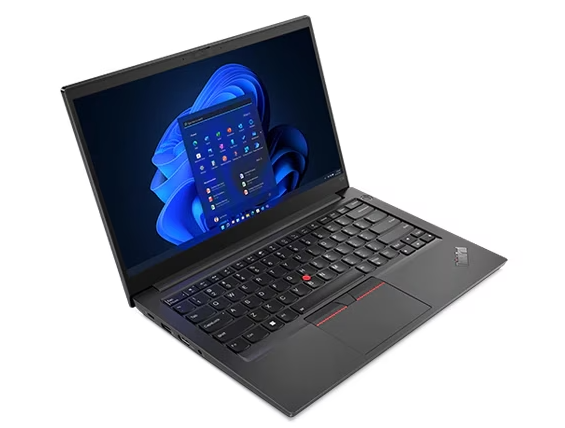
Image Source: Lenovo Official
Who Is It For?
The ThinkPad E14 is for individuals who require a reliable computer for professional or academic work. It is a common choice for office employees, students, and small business owners who need a machine that can survive being carried in a bag every day. The hardware is optimized for multitasking across web browsers, communication tools, and office suites. It is built for functionality and durability rather than for high-end gaming or professional creative arts. If this form factor or power doesn’t quite fit your daily work, exploring other lineup categories would be a better path.
1. Check Before You Buy
The ThinkPad E14 is a laptop designed for consistent daily use in professional and educational settings. It represents the entry point into the ThinkPad lineup, sitting below the T14 and X1 series. Because this series has existed through several generations, the internal configuration—especially the memory and the screen—can vary significantly between a model released two years ago and one released today.
Memory Configuration and Future Upgrades
The way memory is installed in the ThinkPad E14 is a factor for long-term use. In many versions, such as the Gen 2 through Gen 4, a portion of the memory is soldered directly to the motherboard. This means if a unit is purchased with 8GB soldered, only one more stick of memory can be added to the single available slot. If that soldered memory fails, the entire motherboard usually requires replacement. However, newer versions have transitioned to using two standard slots, which allows both sticks of memory to be replaced or upgraded. Checking the specific “Gen” number and the memory layout on the sales page is necessary to understand if the laptop can be upgraded in the future.
Screen Brightness and Lighting Environments
The display brightness is measured in “nits,” and the E14 series often ships with 250-nit or 300-nit screens. A 250-nit screen brightness makes viewing difficult in rooms with large windows or direct sunlight. The matte coating helps reduce reflections from overhead office lights, but it does not compensate for a low brightness level in outdoor settings. For users who work in varied lighting conditions, the 300-nit or 400-nit panel options provide a more visible image. The transition to a 16:10 aspect ratio in newer models means the screen is taller, showing more lines of text in a document compared to older 16:9 widescreen models.
Thermal Management and Fan Behavior
The cooling system in the E14 consists of a single fan and heat pipes that move heat away from the processor. During standard tasks like writing documents or attending video calls, the fan typically remains off or spins at a speed that is difficult to hear. When the processor is pushed with heavy data calculations or multiple background applications, the fan exhausts air through the rear or the side of the chassis. This results in a steady whirring sound. The aluminum chassis versions dissipate heat through the surface of the laptop more effectively than the plastic versions, though the surface can feel warm to the touch during long periods of use.
Performance Limits and Graphics
The integrated graphics system in the E14 is designed for displaying high-resolution video and handling multiple monitors. It is not a gaming laptop or a 3D workstation. While it can handle basic photo editing and short 1080p video clips, it will struggle with complex 3D rendering or modern high-end video games. Attempting to run such software will cause the system temperature to rise and the frame rate to drop. For users whose work involves heavy graphical processing, the integrated hardware in the E14 series will not be enough.
2. How It Fits a Real Desk Setup
The ThinkPad E14 is sized to fit on standard office desks, airplane tray tables, and small coffee shop surfaces. Its 14-inch frame is a standard size for professional portability, providing enough screen space for side-by-side windows without the bulk of a 15 or 16-inch machine.
The Daily Commute and Portability
With a weight starting around 1.4 kg, the E14 fits into most standard backpacks and messenger bags designed for 13 or 14-inch laptops. The power adapter uses a USB-C connection, which means the same charger can often be used for a phone or tablet. The chassis is thin enough to slide into a crowded bag but thick enough to feel substantial. Because the ports are reinforced, frequent plugging and unplugging of the charging cable does not easily loosen the internal connectors. The matte black finish is resistant to some fingerprints, but oil marks from hands will become visible over time with frequent handling.
Desk Connectivity and Port Layout
One of the advantages of the E14 is the inclusion of a full-sized RJ45 Ethernet port. This allows for a stable, wired internet connection in offices or hotels without the need for an external adapter. The HDMI port is also full-sized, making it easy to connect to projectors or external monitors. On a desk, the USB-C port allows for a single-cable connection to a compatible docking station, which can provide power and connect to external peripherals. However, because there is often only one or two USB-C ports, using one for charging limits the availability of high-speed data ports unless a hub is used.
The Typing and Navigation Experience
The keyboard is a central feature of the E14 experience. The keys have a concave shape and a tactile response that is consistent with the ThinkPad brand. The keyboard is also spill-resistant, featuring a drainage system that helps protect the internal electronics from small amounts of liquid. In the center of the keyboard sits the red TrackPoint, which allows for mouse movement without moving the hands away from the typing position. The trackpad below is smooth and supports multi-touch gestures, though it is smaller than those found on consumer-focused laptops to make room for the physical buttons used with the TrackPoint.
Visual and Audio Environment
The 16:10 aspect ratio of the screen provides more vertical space, which is useful for reading long documents or viewing more rows in a spreadsheet. The speakers are located on the bottom of the chassis and fire downward. When the laptop is placed on a hard desk, the sound reflects toward the user, but if the laptop is placed on a lap or a soft surface, the audio can become muffled. The webcam at the top of the screen includes a physical privacy shutter, a sliding piece of plastic that blocks the lens when not in use, providing a visual confirmation that the camera cannot see the user.
3. Performance by Use Case
The following ratings are based on a standard configuration with an Intel Core i5 or AMD Ryzen 5 and 16GB of RAM.
| Use Case | Software | Rating | Reason |
| Office Work | Word, Excel, PowerPoint | Sufficient | Handles large documents and multitasking easily |
| Web Browsing | Chrome, Edge (30+ tabs) | Sufficient | High RAM capacity supports many open tabs |
| Video Calls | Zoom, Microsoft Teams | Sufficient | Clear webcam and stable wired Ethernet connection |
| Photo Editing | Adobe Photoshop | Adequate | Good for basic edits; high-res files may slow down |
| Video Editing | 1080p basic cuts | Adequate | Possible for simple projects; 4K rendering is slow |
| 3D Gaming | AAA Titles (Cyberpunk 2077) | Not enough | Integrated graphics cannot maintain playable speeds |
| Professional 3D | Blender, AutoCAD 3D | Not enough | Lack of dedicated GPU limits complex 3D work |
The ratings above assume the laptop is used on a flat surface to allow for proper airflow. Using the laptop for tasks rated as “Not enough” will lead to high fan noise and potential thermal throttling.
4. Official Specs (with plain explanations)
| Category | Specification | Notes |
| CPU | Intel Core / AMD Ryzen | Efficiency-focused processors, performance varies by generation |
| Graphics | Integrated Intel / AMD Radeon | Built into the processor, uses shared system memory |
| Memory | 8GB to 64GB (Hybrid or Dual Slot) | One soldered chip plus one slot in older models |
| Storage | Up to 2x M.2 NVMe SSD | Dual internal slots available in newer generations |
| Display | 14-inch 16:10 (FHD+ to 2.2K) | Taller screen ratio, matte anti-glare coating |
| Weight | Starting at 1.41 kg (3.11 lbs) | Aluminum and plastic construction options |
| Battery | 47Wh or 57Wh | Internal battery, supports USB-C charging |
| Ports | USB-C, USB-A, HDMI, RJ45, Jack | Includes a full-sized Ethernet port for wired internet |
This series is sold with different CPUs, memory, and storage depending on the release year and generation. Please match the specifications on your current seller page with the official information above.
Source: Lenovo Official Product Page
The specifications listed above define the physical and technical boundaries of the ThinkPad E14. As a 14-inch laptop, it is designed to balance internal hardware capabilities with a frame that is small enough for daily transport. The following sections explain how these technical details translate into the physical experience of using the device in various environments.
5. Main Variations in This Series
- Processor Architecture: The series is available with either Intel Core or AMD Ryzen processors. Intel models often include Thunderbolt 4 support in newer generations, while AMD models utilize different integrated graphics architectures.
- Chassis Material Options: Some configurations feature an aluminum top and bottom cover, while others use a plastic bottom. This choice affects the total weight and the rigidity of the base.
- Memory Slot Design: Older generations typically feature one soldered memory chip and one open slot. Newer generations, such as the Gen 5 and Gen 6, have moved toward two replaceable slots in certain configurations.
- Display Brightness and Panels: Screen options range from 250-nit or 300-nit panels to higher-resolution 2.2K panels. The brightness level determines how visible the screen remains in rooms with many windows.
6. What to Check on the Sales Page
When looking at a ThinkPad E14 listing, the generation and the specific screen brightness are the most important factors that change the value of the machine.
- CPU Generation: Check whether you are getting the 12th Gen, 13th Gen, or the newer Core Ultra processors.
- Memory Configuration: Verify if the RAM is “soldered” or if there are “two SODIMM slots” for future upgrades.
- Screen Brightness (Nits): Look for the brightness rating. A 250-nit screen may be difficult to use in bright rooms; a 300-nit or higher panel is generally preferred.
- Chassis Material: Confirm if the unit has an “Aluminum” or “PC/ABS” (plastic) bottom cover, as this affects weight and durability.
- Keyboard Backlight: Not all E14 models include a backlit keyboard. Confirm this feature if you often work in dark environments.
The specifications on the sales page are the final authority on what is inside the box. Always double-check the RAM and storage totals, as these are frequently customized by sellers.
7. Disclaimer & Buying Advice
This buying guide for the ThinkPad E14 Series is based on official manufacturer specifications and recurring real-world user experiences. It is completely independent, not sponsored, and does not guarantee specific performance for every unit. Hardware configurations such as the processor, memory, and storage can differ by generation and region, so please double-check the exact specifications listed on your seller’s page before purchasing.
8. Beginner Guide
If you are trying to decide which laptop size and series fits your daily life and want to understand the basic differences between models, you can [Start Here] to begin your journey.