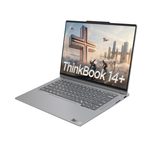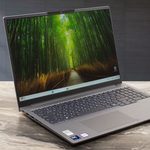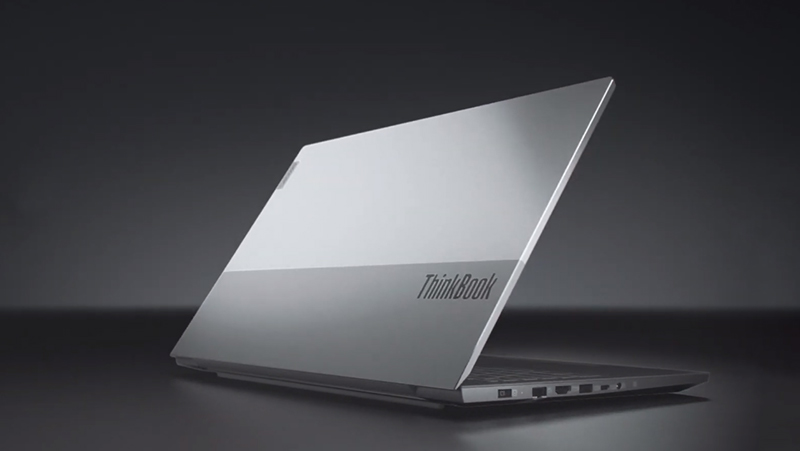
Image Source: Lenovo Official
Who Is It For?
The ThinkBook 15 places a 15.6-inch panel and a compact 65 W USB-C charger on a desk or in a bag for all-day office work, video calls, and multi-app productivity. A student who carries the closed machine between classes and opens it for notes or group projects fits the portable business pattern this series supports. A remote worker who switches between spreadsheets, browser tabs, and external monitors while moving between rooms also matches the daily flow.
The roughly 1.7–1.8 kg body and USB-C charging make bag carries practical, yet memory is often dual SO-DIMM or mixed soldered-plus-slot depending on generation. The 45–60 Wh pack sustains mixed office and media work for several hours away from the wall. If this form factor or power doesn’t quite fit your daily work, exploring other lineup categories would be a better path.
1. Dual SO-DIMM or Mixed Memory, Storage Bays, and Fixed 15.6-Inch Panel
Memory layout varies by generation
Many configurations use two DDR4 or DDR5 SO-DIMM sockets, or one soldered module plus one accessible slot, supporting dual-channel operation up to 32–40 GB. On a desk this means the number of open browser tabs or project layers can be raised later on upgradable units. Confirm the exact memory type and slot count listed on the sales page before ordering.
One or two M.2 bays
Storage typically includes one or two M.2 PCIe slots, so capacity can grow by adding a second drive on dual-bay models. After purchase an owner can expand storage for larger document libraries, while RAM remains expandable on most units. Check the product page to see whether both drive bays are present and already occupied.
15.6-inch panel locked at purchase
Screen options stay fixed once ordered: primarily 15.6-inch FHD (1920×1080) IPS panels at 60 Hz. The lid opens to 180 degrees on many units for lay-flat sharing. Color coverage and brightness remain those of the selected panel for the life of the machine. Anyone needing an external higher-resolution monitor relies on the HDMI or USB-C DisplayPort output. Verify the exact resolution printed on the sales listing before ordering.
These physical limits keep capacity choices expandable on most models and tie the display choice to the original panel.
2. Compact Footprint, Desk Clearance, and Daily Carry
18.9 mm closed profile on a shared surface
The chassis measures approximately 357 × 235 × 18.9 mm. On a small café table or folding desk the thin profile leaves usable surface for a mouse. The 15.6-inch lid needs clear depth in front of the keyboard so the screen can open fully without striking a wall or secondary monitor stand. Daily placement favors surfaces that support the compact footprint without crowding.
Side and rear vents under load
Cooling air moves through the chassis and exits at the sides or rear. Soft bedding or a closed bag can restrict airflow during sustained multi-core activity. On a hard desk the fans stay relatively quiet during light browser or document work and ramp only under prolonged load. The metal or plastic underside transfers limited heat to the surface beneath it during long sessions.
1.7–1.8 kg notebook plus compact charger for any move
The machine alone starts near 1.7 kg. Adding the 65 W USB-C adapter keeps the total under 2 kg in most cases. A short walk between rooms or a daily commute in a slim sleeve remains easy. The 45–60 Wh battery covers mixed office, video calls, and media work for several hours away from the wall, so extended mobile sessions often need occasional top-ups.
3. Performance by Use Case
Configurations pair Intel Core or AMD Ryzen processors with integrated graphics. All work runs on the internal battery or the USB-C charger; discrete GPUs appear only on select higher models.
| Use Case | Software | Rating | Reason |
|---|---|---|---|
| Multi-app office and browser | Office, Chrome, Teams | Sufficient | Dual-channel RAM and CPU cores handle concurrent light loads |
| Video calls and note-taking | Zoom, OneNote, Teams | Sufficient | Dual mics, privacy shutter, and battery sustain full-day sessions |
| Coding and multi-tab work | VS Code, many browser tabs | Adequate | Higher memory configurations keep large projects open |
| Light photo and document work | Photos, PDF editing | Adequate | Integrated graphics sustain basic edits while powered |
| Battery-only heavy rendering or gaming | Long exports or demanding titles | Not enough | Integrated graphics and thin cooling restrict sustained high loads |
Lower memory configurations reduce the margin on the middle rows.
4. Official Specs (with plain explanations)
| Category | Specification | Notes |
|---|---|---|
| Display | 15.6″ FHD IPS, 60 Hz | Fixed; anti-glare; 180° hinge on many |
| Processor | Intel Core / AMD Ryzen series | Soldered; generation varies by SKU |
| Graphics | Integrated Intel / AMD Radeon | Shared system memory |
| Memory | Dual SO-DIMM or mixed soldered + slot, up to 32–40 GB | Removable on most |
| Storage | 1–2× M.2 PCIe | Dual-bay expansion on many |
| Battery | 45–60 Wh | Rapid Charge support |
| Adapter | 65 W USB-C | Charges via USB-C ports |
| Weight | Starting at ~1.7–1.8 kg | With battery |
| Ports | USB-A, USB-C (PD/DP/TB4 on many), HDMI, Ethernet, SD, audio | Side-mounted |
This series is sold with different CPUs, memory, and storage depending on the release year and generation. Please match the specifications on your current seller page with the official information above.
Source: Lenovo Official Product Page
The memory slot layout and battery capacity listed above directly set later upgrade paths and daily unplugged runtime.
5. Main Variations in This Series
Starting memory of 8–16 GB versus higher dual-channel capacity affects how many browser tabs or project layers stay open. Processor choice among Intel or AMD alters multi-core and everyday tasks. Battery capacity between 45 Wh and 60 Wh changes the length of light work away from the wall. Storage starting size and dual-bay presence change how large document libraries can grow. Each of these choices is fixed after purchase only on fully soldered models; SO-DIMM and dual M.2 units remain expandable.
6. What to Check on the Sales Page
Confirm the exact hardware listed for the SKU you are considering, because the same series name covers multiple generations and platforms.
- CPU platform: Check whether you are getting Intel Core or AMD Ryzen.
- Exact memory type (dual SO-DIMM or mixed) and capacity.
- Number of M.2 slots and storage size.
- Exact screen resolution.
- Battery rating (45–60 Wh range) and included 65 W USB-C adapter.
Matching these five items against the official sheet prevents receiving a lower-capacity or older configuration under the same series name.
7. Disclaimer & Buying Advice
This buying guide for the ThinkBook 15 is based on official manufacturer specifications and recurring real-world user experiences. It is completely independent, not sponsored, and does not guarantee specific performance for every unit. Hardware configurations such as the processor, memory, and storage can differ by generation and region, so please double-check the exact specifications listed on your seller’s page before purchasing.
8. Beginner Guide
The dual SO-DIMM (or mixed) memory layout and the 45–60 Wh battery set the daily capacity and unplugged boundaries of this series more than any other factor. Start Here walks through how those fixed constraints interact with common desk, office, and light-carry patterns before any purchase decision.