Image Source: Tech Reviewer / Hands-on Photo
Who Is It For?
The NUC 14 Pro is used by office professionals who require a compact and reliable machine for document editing, web research, and video conferencing. It fits the needs of home users who want a small computer for media streaming and light photo editing that can be hidden behind a TV or monitor. It also serves as a workstation for developers or IT professionals who need a system with multiple high-speed ports and the ability to upgrade RAM and storage. The small footprint and VESA mounting options make it a choice for those who prioritize a clean and minimalist workspace.
If this form factor or power doesn’t quite fit your daily work, exploring other lineup categories would be a better path.
1. Check Before You Buy
Chassis Height and Storage Expansion
The choice between the Slim and Tall chassis determines the physical storage options for the NUC 14 Pro. The Slim model is designed for a minimal footprint and only accommodates M.2 NVMe drives, which are small, stick-shaped storage modules. The Tall model is approximately 17 mm higher and includes a mounting bracket and a SATA cable for a 2.5-inch drive. This allows for the installation of high-capacity, lower-cost storage drives alongside the primary M.2 SSD. If a user intends to store large amounts of data locally without using external drives, the Tall chassis provides the necessary internal space. The width and depth of both models remain identical at 117 mm by 112 mm.
Tool-less Access and Internal Layout
The NUC 14 Pro features a chassis design that allows for internal access without the use of a screwdriver. The bottom panel is held in place by a latch mechanism. Once the panel is removed, the memory slots and storage bays are visible. There are two SO-DIMM slots for DDR5 memory, which are the same type of modules used in laptops. The system supports up to 96GB of total RAM. There are also two M.2 slots: one 2280 slot (80 mm long) and one 2242 slot (42 mm long). For those purchasing a Barebone kit, this physical access is required for the initial installation of components. For those with a Full System, it allows for future hardware changes as software requirements increase.
Thermal Management and Fan Noise
The cooling system consists of a single fan and a heatsink that move thermal energy away from the Intel Core Ultra processor. During basic tasks like document editing or web browsing, the fan operates at a low speed that is difficult to hear in a standard room. When the system is under a heavy load, such as during high-resolution video exports or system updates, the fan speed increases. This results in a steady air-rushing sound from the rear and side vents. Because the chassis is small, the fan must spin faster to move heat away from the components compared to a large desktop tower. Placing the unit in a confined space, such as a closed cabinet, will cause the internal temperatures to rise and the fan to spin more frequently.
External Power Adapter Dimensions
A significant physical detail of the NUC 14 Pro is the external power adapter. Because the PC chassis is only 0.5 to 0.7 liters in volume, the electrical conversion hardware is located in a separate “brick” outside the main unit. This power adapter is a separate unit that must be placed on the desk or floor. The size of the adapter varies based on the processor; the Core Ultra 7 models typically include a larger 120W adapter. When planning a workspace, space must be allocated for this adapter and its cables. The cable connecting the adapter to the PC is a fixed length, which is a factor in cable management for a clean desk setup.
Performance Limits of Integrated Graphics
The graphics processing is handled by the integrated Intel Arc chip. Unlike a dedicated graphics card found in gaming desktops, this chip shares the system memory (RAM) to process visuals. While it handles 4K video playback and standard photo editing, the performance in 3D applications is limited by the shared memory architecture. The system supports up to four simultaneous 4K displays through the two HDMI 2.1 ports and the two Thunderbolt 4 ports. However, running four high-resolution monitors simultaneously increases the load on the integrated graphics, which can affect the overall responsiveness of the system during intensive tasks.
2. How It Fits a Real Desk Setup
VESA Mounting and Monitor Integration
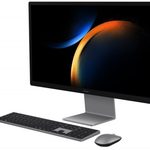
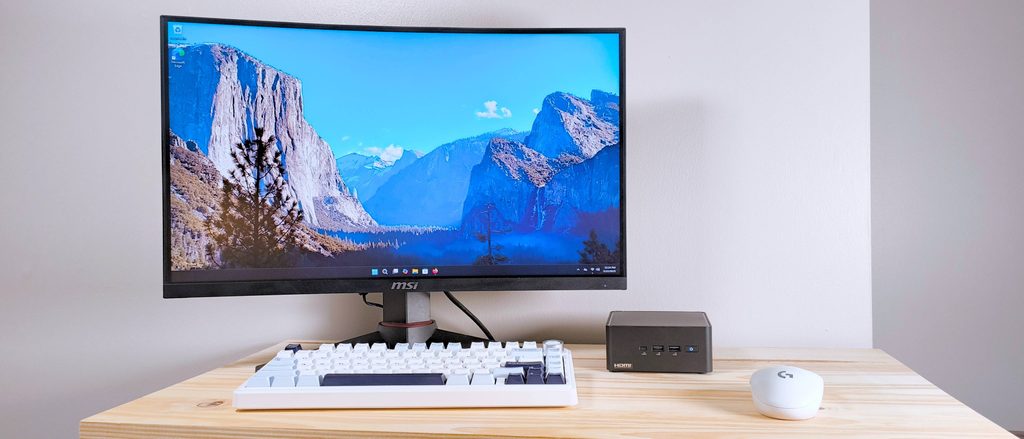
The NUC 14 Pro includes a VESA mounting bracket in the box. This bracket allows the PC to be attached directly to the back of a compatible monitor or television. When mounted this way, the PC is hidden from view, and the only visible components on the desk are the monitor, keyboard, and mouse. This setup effectively turns a standard monitor into an all-in-one computer. However, mounting the PC on the back of a monitor makes the physical ports less accessible. Users who frequently connect thumb drives or headsets may find this orientation less convenient than placing the unit on the desk surface.
Port Layout and Cable Management
The ports are distributed between the front and the rear of the chassis. The front panel includes two USB-A ports and one USB-C port, which are intended for temporary connections like thumb drives or mobile devices. The rear panel houses the primary connections, including the two HDMI 2.1 ports, the two Thunderbolt 4 ports, and the 2.5G Ethernet jack. This rear-heavy layout allows for permanent cables to be routed away from the user, keeping the front of the desk clear. Because the unit is very light, the weight of multiple thick cables (like HDMI and Power) can pull on the chassis, potentially causing it to slide on the desk surface if not secured.
Thunderbolt 4 and Docking Capabilities
The two Thunderbolt 4 ports on the rear provide high-speed data transfer and video output. These ports allow for the connection of a Thunderbolt dock, which can manage multiple peripherals through a single cable. This is a factor for users who want to quickly disconnect the NUC and move it to another location. The Thunderbolt ports also support daisy-chaining, where multiple devices are connected to each other in a series. This reduces the number of cables connected directly to the PC. The ports are located close together, so using wide USB-C connectors may block the adjacent port.
Wireless Connectivity and Signal Range
The system includes built-in Wi-Fi 6E and Bluetooth 5.3 antennas. These antennas are located inside the plastic and metal chassis. While this eliminates the need for external antennas protruding from the rear, the signal range can be affected by the placement of the unit. If the NUC is placed behind a large metal monitor or inside a desk drawer, the wireless signal strength may decrease. The 2.5G Ethernet port provides a stable wired connection for tasks that require consistent data speeds, such as large file transfers or video conferencing. The Bluetooth connection allows for the use of wireless keyboards and mice, further reducing cable clutter on the desk.
Noise Profile in Different Environments
The sound produced by the NUC 14 Pro varies based on the task being performed. In a quiet home office, the fan is audible during system updates or when multiple browser tabs are loading. In a busy office environment with background noise, the fan is often indistinguishable from the ambient sound. The “Tall” version has slightly more internal air volume, but the fan size and noise profile are consistent across both chassis types. The system BIOS allows for the selection of different fan profiles, such as “Quiet” or “Cool,” which changes how the fan reacts to temperature changes.
3. Performance by Use Case
The performance of the NUC 14 Pro is determined by the specific CPU and the amount of RAM installed. The following ratings assume a configuration with 16GB of RAM.
| Use Case | Software | Rating | Reason |
| Office Productivity | Excel, Word, Outlook | Sufficient | Fast response times and supports multiple monitors |
| Web Browsing | Chrome, Edge (20+ tabs) | Sufficient | 16GB+ RAM handles many active tabs without lag |
| 4K Video Playback | YouTube, Netflix, Plex | Sufficient | Integrated Arc graphics handle 4K 60Hz easily |
| Photo Editing | Photoshop, Lightroom | Adequate | Possible for basic edits, but integrated GPU has limits |
| AAA Gaming | Cyberpunk 2077, Starfield | Not enough | Integrated graphics are not intended for heavy 3D games |
The ratings above reflect the capabilities of the hardware when connected to the external power adapter. Performance in specific applications will depend on the complexity of the project files and the thermal environment.
4. Official Specs (with plain explanations)
| Category | Specification | Notes |
| CPU | Intel Core Ultra 5 / 7 (Series 1) | Integrated AI NPU, efficiency-focused architecture |
| Graphics | Intel Arc Graphics | Integrated, shared system memory |
| Memory | Up to 96GB DDR5-5600 (SO-DIMM) | Two physical slots, user-replaceable |
| Storage | 1x M.2 2280, 1x M.2 2242 (PCIe Gen4) | Internal expansion, Tall version adds SATA |
| Dimensions | 117 x 112 x 37 mm (Slim) / 54 mm (Tall) | Two chassis height options available |
| Connectivity | Wi-Fi 6E, Bluetooth 5.3, 2.5G LAN | Modern wireless and wired standards |
| Ports | 2x Thunderbolt 4, 2x HDMI 2.1, USB-A | Supports four simultaneous 4K displays |
| Power | External Power Adapter (90W / 120W) | Separate unit, wattage varies by CPU |
This series is sold with different CPUs, memory, and storage depending on the release year and generation. Please match the specifications on your current seller page with the official information above.
Source: ASUS Official Product Page
The technical specifications of the NUC 14 Pro define its capabilities as a stationary computing system in a small physical format. These components are housed within a standardized chassis that allows for airflow and physical access to internal parts. Understanding these specifications is necessary to determine how the system will function in a home or office environment.
5. Main Variations in This Series
The NUC 14 Pro series features several hardware combinations that change the processing speed and physical storage capacity. These variations are determined by the specific model chosen at the time of purchase.
- The chassis is available in two heights: the “Slim” version (37 mm) and the “Tall” version (54 mm).
- The Tall version includes an internal bay for a 2.5-inch SATA SSD or HDD, while the Slim version only supports M.2 drives.
- Processor options include the Intel Core Ultra 5 and the Intel Core Ultra 7, which feature different core counts and clock speeds.
- The system is sold as a “Full System” with pre-installed RAM, SSD, and Windows, or as a “Barebone” kit which requires the user to provide their own memory, storage, and operating system.
- Power adapter wattage varies between 90W and 120W depending on the thermal requirements of the installed processor.
6. What to Check on the Sales Page
When viewing a NUC 14 Pro listing, the specific chassis type and the “Barebone” status are the most important details to verify. Sellers often list different versions under the same series name.
- System Type: Confirm if the listing is for a “Full System” (includes RAM/SSD/OS) or a “Barebone” kit.
- Chassis Height: Check if the model is the “Slim” (37 mm) or “Tall” (54 mm) version based on your storage needs.
- CPU Model: Check whether you are getting the Intel Core Ultra 5 or the Core Ultra 7 processor.
- Memory/Storage: If it is a Full System, check the specific amount of RAM (16GB/32GB) and SSD (512GB/1TB) included.
- CPU Generation: Check whether you are getting the Intel Core Ultra (Series 1) processors.
The specifications on a retail page can sometimes be generalized. Matching the manufacturer’s part number with the official datasheet is the most accurate way to confirm the internal hardware.
7. Disclaimer & Buying Advice
This buying guide for the NUC 14 Pro is based on official manufacturer specifications and recurring real-world user experiences. It is completely independent, not sponsored, and does not guarantee specific performance for every unit. Hardware configurations such as the processor, memory, and storage can differ by generation and region, so please double-check the exact specifications listed on your seller’s page before purchasing.
8. Beginner Guide
If you are new to choosing computer hardware and want to understand the basics of these components, you can [Start Here] to learn more about how to read specifications.