
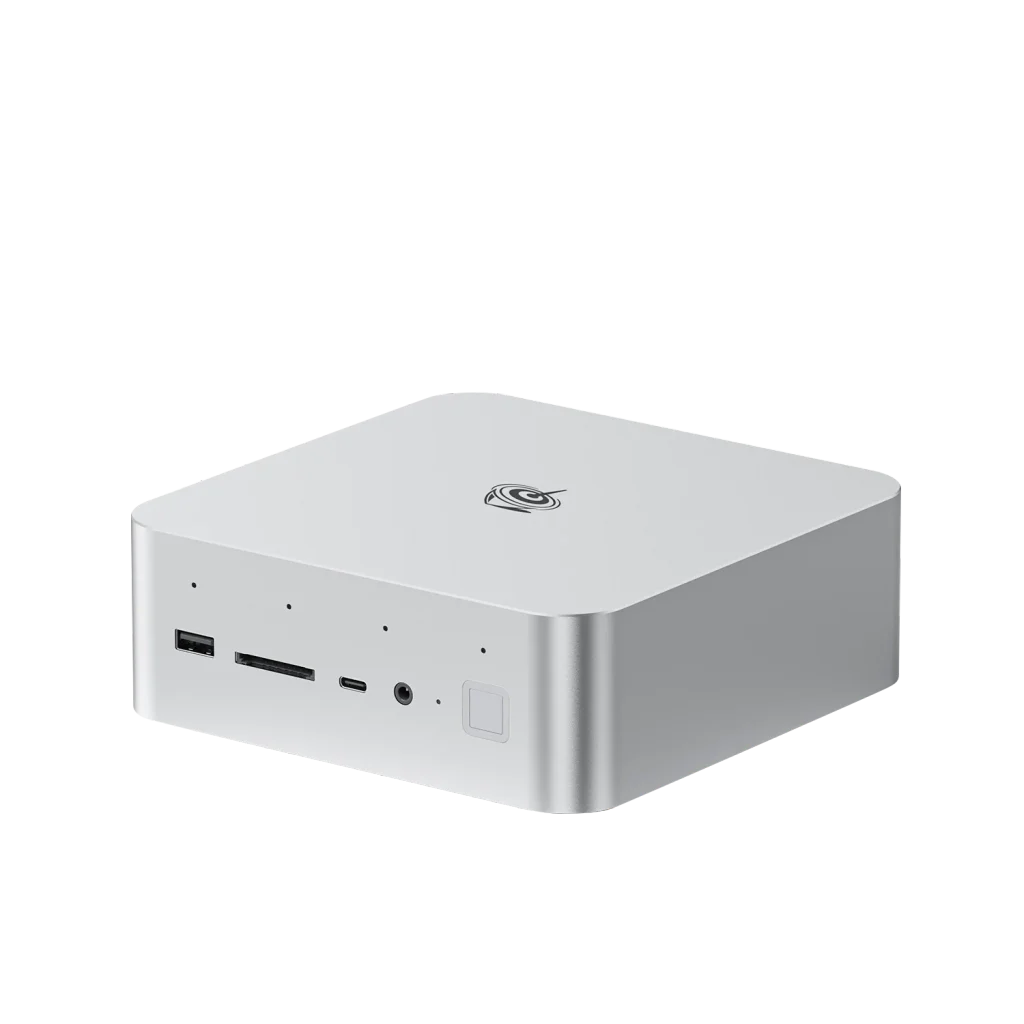
Image Source: Beelink Official
Who Is It For?
Beelink Mini PC models occupy a palm-sized chassis that sits on a desk, behind a monitor via VESA mount, or inside a small media cabinet for office productivity, light media servers, or multi-monitor workstations. Users who run web browsers, office suites, local file serving, or dual 4K displays from a tiny footprint fit the daily pattern. The fixed external or internal power brick and fan cooling replace any portable battery or screen. Many configurations allow RAM and storage expansion through SO-DIMM and M.2 slots after purchase. Idle power stays low while sustained loads raise fan noise. If this form factor or power doesn’t quite fit your daily work, exploring other lineup categories would be a better path.
1. Fixed Chassis Size and Expansion Limits
Compact dimensions that stay put
Most Beelink Mini PC units measure roughly 11–13 cm on each side and 4–5 cm tall (some cube-style models approach 10 cm cubes). The volume never changes after purchase. On a crowded desk the box claims a small but permanent rectangle of surface; behind a monitor via optional VESA mount it disappears. Confirm the exact exterior measurements listed for the chosen model so the intended placement remains clear.
Power brick or internal supply
Power arrives through an external adapter (commonly 36–85 W or higher) or a built-in supply on select models. The brick occupies an extra wall outlet or power strip slot and must remain connected at all times. There is no battery. Verify whether the listed unit uses an external brick or internal PSU and the exact wattage required.
RAM and storage slots
Many models provide one or two SO-DIMM slots for DDR4 or DDR5 memory and one or two M.2 NVMe slots. Entry-level units sometimes solder the memory or limit the second drive bay. After opening the bottom panel the owner can usually add or replace modules, yet the maximum supported capacity is fixed by the board. Check the sales page for the number of free slots and the supported maximum RAM and SSD size.
These physical limits keep the machine oriented toward permanent desk or mounted placement and allow limited internal upgrades on most configurations.
2. Desk Footprint, Fan Noise, and Multi-Monitor Use
Surface and mounting space
The small footprint fits beside a keyboard or mounts behind a monitor with a VESA bracket. On a shared office desk the rear ports (HDMI, USB, Ethernet) require clearance for cables. Soft surfaces or enclosed cabinets can restrict the underside intake vents and raise internal temperatures.
Fan behavior under load
A single fan or dual-fan setup keeps the system near silent at idle (often under 35 dB). Under multi-core office loads or light media encoding the fan speed rises and becomes audible within a quiet room. Continuous high loads produce a steady low hum rather than aggressive laptop-style noise. Confirm whether the chosen model emphasizes silent cooling or higher TDP performance.
Multi-monitor and peripheral capacity
Dual HDMI ports or HDMI plus USB-C with DisplayPort support two or three external displays at 4K60 on most units. USB-A and USB-C ports handle keyboards, mice, external drives, and docks. Dual Ethernet appears on many office-oriented models for separate networks. These interfaces are fixed after purchase.
3. Performance by Use Case
Configurations range from low-power Intel N-series or older Celeron chips to Ryzen 5/7 or Core Ultra processors with integrated graphics. All ratings assume the unit remains plugged in; there is no battery mode.
| Use Case | Software | Rating | Reason |
|---|---|---|---|
| Office and multi-browser productivity | Word, Excel, Chrome with many tabs | Sufficient | Multi-core CPUs and dual-channel RAM keep concurrent work smooth |
| Dual or triple 4K media playback | Streaming apps, local video | Sufficient | Dual HDMI or HDMI + DP outputs sustain multiple high-resolution screens |
| Light photo editing and file serving | Lightroom, local NAS roles | Adequate | Integrated graphics and SSD slots handle moderate media libraries |
| Sustained heavy 4K export or modern gaming | Premiere, recent AAA titles | Not enough | Most models lack discrete GPUs and high sustained TDP cooling |
| Always-on low-power home server | Media server, light Docker | Sufficient | Idle power often stays under 15 W with quiet fans |
Lower-power N-series configurations reduce the margin on the first three rows. Discrete graphics expansion is absent on nearly all current Beelink Mini PC models.
4. Official Specs (with plain explanations)
| Category | Specification | Notes |
|---|---|---|
| Chassis | Approx. 11–13 cm square × 4–5 cm tall | Varies by model; some cubes ~10 cm |
| Processor | Intel N-series / Core / AMD Ryzen | Soldered |
| Graphics | Integrated (UHD / Radeon) | No discrete GPU on most |
| Memory | 1–2× SO-DIMM DDR4/DDR5 (some LPDDR soldered) | Upgradable on many models |
| Storage | 1–2× M.2 NVMe (some + 2.5″ bay) | Upgradable |
| Power | External 36–120 W brick or internal PSU | Always required |
| Weight | Typically 0.3–0.8 kg (device only) | Without adapter |
| Ports | Dual HDMI or HDMI + USB-C DP, multiple USB, 1–2 Ethernet | Fixed layout |
This series is sold with different processors, memory, and storage depending on the model and generation. Please match the specifications on your current seller page with the official information above.
Source: Beelink Official Product Page
The compact fixed size and available SO-DIMM / M.2 slots listed above directly determine desk placement and later expansion.
5. Main Variations in This Series
Processor choice among N-series, Core, or Ryzen chips changes multi-core headroom for office multitasking and light media work. Memory starting capacity and the presence of SO-DIMM slots determine whether capacity can grow later. Storage of one versus two M.2 bays (or an added 2.5-inch bay) alters how much local data stays internal. Dual Gigabit or 2.5 GbE Ethernet versus single LAN changes network flexibility. Some models integrate the power supply while others rely on an external brick. Each of these choices is fixed after purchase except for the modules that fit the available slots.
6. What to Check on the Sales Page
Confirm the exact hardware listed for the SKU you are considering, because the same series name covers many different chassis and performance levels.
- Exact processor model and TDP so sustained performance is clear.
- Number of SO-DIMM slots and maximum supported RAM.
- Number of M.2 slots (and any 2.5-inch bay) plus pre-installed drive size.
- Whether power is supplied by an external brick or internal PSU and the wattage.
- Video outputs (dual HDMI, HDMI + USB-C DP) and Ethernet speed (1 GbE, 2.5 GbE, or higher).
Matching these five items against the official sheet prevents receiving a lower-expansion or lower-power configuration under the same series name.
7. Disclaimer & Buying Advice
This buying guide for the Beelink Mini PC series is based on official manufacturer specifications and recurring real-world user experiences. It is completely independent, not sponsored, and does not guarantee specific performance for every unit. Hardware configurations such as the processor, memory, and storage can differ by model and region, so please double-check the exact specifications listed on your seller’s page before purchasing.
8. Beginner Guide
The fixed palm-sized chassis and the presence or absence of free SO-DIMM and M.2 slots define the daily limits of this series more than any other factor. [Start Here] walks through how those constraints interact with common desk, mounted, and always-on patterns before any purchase decision.

[…] Beelink Mini PC Series — Space-efficient mini PC for everyday use […]