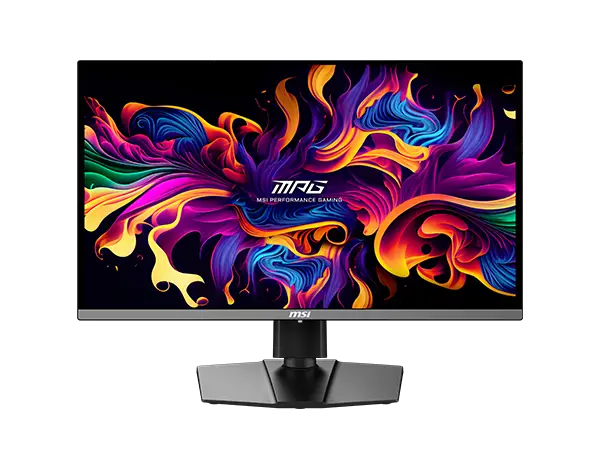
Image Source: MSI Official
Who Is It For?
The MSI MPG series fits users who require a high-performance gaming display that also functions as a productivity hub for multiple devices. This series suits gamers who use both a high-end PC and a modern laptop, as the integrated KVM switch—a hardware feature that allows one set of peripherals to control two computers—and high-wattage USB-C power delivery simplify the desk setup. Because the line includes QD-OLED (Quantum Dot Organic Light Emitting Diode) models, it fits enthusiasts who play in dark, light-controlled environments and want “infinite” contrast where black areas of the screen are physically dark rather than glowing gray.
However, this series does not fit users on a strict budget who only need basic display functions, as the price includes premium features like Mystic Light RGB and advanced cooling systems. It is not for users who primarily perform 10-hour workdays of static spreadsheet management, as the OLED models carry a physical risk of “burn-in”—permanent image retention from static UI elements. The MPG series also does not fit those with very shallow desks, as the stands are physically deep to support the weight of the premium panels. If this form factor or the specific feature set doesn’t quite fit your daily work, exploring other lineup categories would be a better path.
1. How This Line Is Grouped
MSI organizes its monitors into three main tiers: MAG (Arsenal), MPG (Performance), and MEG (Enthusiast). The MPG series is the “Performance” tier, positioned as the high-end mainstream choice. It offers better build materials, more advanced software integration, and higher power delivery than the MAG series.
| Tier | Typical Names | Rough Position |
| MPG LCD (Rapid IPS) | MPG 271QR, MPG 321UR-QD | High-speed IPS panels, 1440p to 4K, flat screens. |
| MPG QD-OLED | MPG 271QRX, MPG 321URX | Self-emissive pixels, 240Hz to 360Hz, flagship speed. |
| MPG Ultrawide | MPG 341QR, MPG 491CQP | 21:9 or 32:9 aspect ratios, curved for immersion. |
MPG LCD (Rapid IPS) Group
This group utilizes “Rapid IPS” technology. Standard IPS (In-Plane Switching) is known for accurate colors and wide viewing angles, but older versions were slow. Rapid IPS uses thinner liquid crystal layers to achieve faster response times—the time it takes for a pixel to change color. These models often include a “Quantum Dot” (QD) layer, which is a film of nanocrystals that enhances color vibrancy, particularly in reds and greens. These are physically flat monitors suited for both gaming and color-accurate creative work.
MPG QD-OLED Group
The QD-OLED models represent the current peak of the MPG line. Unlike LCDs, these do not have a backlight; every pixel produces its own light. This allows for a 0.03ms response time, which is physically impossible for any LCD to reach. The MPG versions of these OLEDs are distinguished from the lower MAG versions by offering higher USB-C Power Delivery (typically 90W) and integrated RGB lighting on the rear. These models are the primary choice for users who prioritize motion clarity and HDR (High Dynamic Range) performance.
MPG Ultrawide Group
The ultrawide models provide a wider field of view than a standard 16:9 screen. The MPG 341QR uses a 21:9 aspect ratio, while the MPG 491CQP uses a 32:9 “Super Ultrawide” ratio, which is equivalent to two 27-inch monitors placed side-by-side without a plastic border in the middle. These models are almost always curved (1000R or 1800R) to keep the edges of the wide screen within the user’s peripheral vision.
2. Check Before You Buy
OLED Care 2.0 and Maintenance Cycles
The MPG QD-OLED models include “MSI OLED Care 2.0,” a suite of software features designed to prevent burn-in. This includes “Pixel Shift,” which subtly moves the image, and “Static Screen Detection,” which dims the screen if no movement is detected. A physical requirement of these monitors is the “Pixel Refresh” cycle. After several hours of use, the monitor will prompt the user to run a cleaning cycle that takes several minutes. During this time, the monitor cannot be used. Users who find these interruptions disruptive should consider the LCD models instead.
Text Fringing and Subpixel Layout
The QD-OLED panels in the MPG series use a non-standard subpixel arrangement. Standard Windows and macOS software is designed for a horizontal “RGB” stripe layout. Because the QD-OLED subpixels are arranged differently, text can exhibit “fringing”—a faint green or magenta shadow on the edges of black letters. While the high resolution of 4K models (like the 321URX) makes this difficult to see, users who spend all day reading small code or text may find it less sharp than a traditional IPS panel.
USB-C Power Delivery (65W vs. 90W)
A key feature of the MPG series is the USB-C port, but the wattage varies by model. Some MPG models provide 65W of Power Delivery (PD), while newer OLED models provide 90W. Power Delivery is the ability of the monitor to charge a connected laptop. A 65W output is sufficient for a 13-inch laptop, but a powerful 16-inch workstation laptop may require 90W to stay charged during heavy use. If the wattage is too low, the laptop battery may still drain while plugged into the monitor.
Glossy vs. Matte Surface Reflections
The MPG QD-OLED models typically feature a glossy screen surface. Glossy screens make colors look more vibrant and blacks look deeper, but they reflect room lights and windows like a mirror. Furthermore, because these panels lack a traditional polarizing layer, ambient light can cause the “blacks” to take on a dark purple tint. To see the intended contrast, the monitor must be used in a room where the user can control the lighting. The MPG LCD models usually feature a matte coating that diffuses light but can make the image look slightly less “crisp.”
3. How It Fits a Real Desk Setup
Stand Footprint and Desk Depth
MPG monitors often use a heavy, wide-spreading stand. On a desk with a depth of 60 cm (24 inches), the legs of the stand can occupy up to 25 cm of depth, leaving limited room for a large mousepad or a keyboard. The stands provide height, tilt, and swivel adjustments, but the physical weight of the premium panels requires a sturdy desk surface. Some newer MPG OLED models have moved to a flatter, square-shaped base to reclaim desk space, but the overall depth remains a factor.
KVM Switch and Peripheral Management
The built-in KVM switch allows a user to plug their mouse and keyboard directly into the monitor’s USB-A ports. When the user switches the video input from their desktop PC to their laptop (via USB-C), the mouse and keyboard signals automatically switch to the laptop. This fits a desk setup where a user wants to keep their workspace clean and avoid swapping cables. However, this requires a “USB Upstream” cable to be connected to the desktop PC, adding one more wire to the initial setup.
Mystic Light RGB and Wall Reflections
The MPG series features “Mystic Light” RGB LEDs on the back of the monitor. These can be synchronized with other MSI components or set to a static color. If the desk is placed against a white or light-colored wall, the LEDs will reflect off the wall, providing “bias lighting.” Bias lighting can reduce eye strain in dark rooms by providing a soft glow behind the screen, which reduces the harsh contrast between the bright monitor and the dark room.
VESA Mounting and Recessed Ports
For users who prefer a monitor arm, the MPG series supports the VESA 100×100 standard—the standard screw pattern for a monitor arm. The mounting area is often recessed (sunken) into the back of the chassis. Some universal monitor arm plates are too wide to fit into this square hole, requiring the use of “standoff” screws (small metal extensions) that are usually included in the MSI box. The ports face downwards, which is a physical fit for wall-mounting as the cables do not stick out toward the wall.
4. Sizes and Models in This Line
The MPG line covers the most common gaming and productivity sizes, with resolutions ranging from 1440p to 4K.
| Size | Common Resolution | Aspect Ratio | Notes |
| 27″ | 2560 x 1440 (QHD) | 16:9 | The “sweet spot” for 27-inch sharpness; 360Hz OLED available. |
| 32″ | 3840 x 2160 (4K) | 16:9 | High detail; 240Hz OLED is the flagship 16:9 model. |
| 34″ | 3440 x 1440 (UWQHD) | 21:9 | Ultrawide; provides extra horizontal vision for simulators. |
| 49″ | 5120 x 1440 (DQHD) | 32:9 | Super-Ultrawide; equivalent to two 27-inch screens. |
The 27-inch 1440p models (like the MPG 271QRX) are the most popular for high-speed gaming. At this size, the resolution is sharp enough that individual pixels are difficult to see at a normal viewing distance of 60 cm. The 360Hz refresh rate—how many times the image updates each second—provides extremely smooth motion for competitive games.
The 32-inch 4K models (like the MPG 321URX) are for users who prioritize detail. 4K resolution (3840 x 2160) provides four times the pixels of 1080p. This fits users who watch 4K movies or perform high-resolution video editing. These models are physically large and usually require a desk depth of at least 70 cm to be used comfortably.
The 49-inch Super-Ultrawide (MPG 491CQP) is a specialized model. It is 120 cm (47 inches) wide. On a standard desk, this monitor replaces a dual-monitor setup. It is a physical fit for users who work with long timelines in video editing or massive spreadsheets. It requires a very sturdy desk and a wide workspace.
5. Performance by Use Case
The performance of an MSI MPG monitor is defined by its panel type (IPS vs. QD-OLED) and its refresh rate.
| Use Case | Software / Task | Rating | Reason |
| Competitive Gaming | Valorant, CS2, Apex | Sufficient | High refresh rates (240Hz-360Hz) and low input lag. |
| Cinematic Gaming | Cyberpunk 2077, Elden Ring | Sufficient | QD-OLED models provide perfect blacks and vibrant HDR. |
| Console Gaming | PS5, Xbox Series X | Sufficient | HDMI 2.1 models support 4K 120Hz and VRR. |
| Office Work | Excel, Word, Outlook | Adequate | Good space, but OLED models have burn-in risk and fringing. |
| Video Editing | Premiere Pro, Resolve | Sufficient | 99% DCI-P3 color coverage and high resolution. |
| Photo Editing | Photoshop, Lightroom | Adequate | Excellent color, but OLED subpixel layout affects fine lines. |
The “Sufficient” rating for cinematic gaming is due to the “infinite” contrast of the OLED models. Contrast is the difference between the brightest and darkest parts of an image. Because OLED pixels can turn off completely, the black levels are physically perfect, which is a requirement for immersive gaming in dark rooms.
6. Official Specs (with plain explanations)
| Category | Specification | Notes |
| Refresh Rate | 144Hz to 360Hz | How many times the image updates each second. |
| Response Time | 1ms (IPS) / 0.03ms (OLED) | Time for a pixel to change color; lower is better. |
| Brightness | 250 nits (SDR) / 1000 nits (HDR Peak) | Nits = unit of brightness; 1000 is for small highlights. |
| Panel Type | Rapid IPS or QD-OLED | IPS = bright/durable; OLED = contrast/speed. |
| Color Gamut | 97% – 99% DCI-P3 | The range of colors the monitor can physically show. |
| Connectivity | HDMI 2.1, DP 1.4, USB-C | HDMI 2.1 is required for 4K 120Hz on consoles. |
| Power Delivery | 15W to 90W | The amount of power sent to a laptop via USB-C. |
This line is sold with different tier names, sizes, refresh rates, and panels depending on the exact model and region. Please match the specifications on your current seller page with the official information above.
Source: MSI Official Product Page
The “GtG” (Gray to Gray) response time of 0.03ms on OLED models is a physical characteristic of the technology. Because there are no liquid crystals to move, the pixels can change state almost instantly, which eliminates “ghosting”—a blurry trail behind moving objects.
7. Main Variations in This Line
The most significant variation is the panel technology. “Rapid IPS” models are the durable, bright choice for daytime gaming and mixed office use. “QD-OLED” models are the premium choice for contrast and motion clarity but require more care regarding static images.
Another variation is the “Quantum Dot” (QD) layer. Models with “QD” in the name (like the MPG 321UR-QD) use a film of nanocrystals to produce more saturated colors. While this makes games look more vibrant, it can sometimes make colors look “unnatural” or oversaturated for professional work unless the monitor is calibrated.
The “Power Delivery” (PD) wattage is a critical variation. Older or lower-tier MPG models may only offer 15W or 27W, which is not enough to charge a laptop. Newer flagship models offer 65W or 90W. A user who wants a single-cable laptop setup must verify the specific PD wattage on the sales page.
8. What to Check on the Sales Page
- Line / Tier / Size: Check whether you are getting the MPG model, not a MAG (Arsenal) or G-series (Budget) model, as the build quality and features differ.
- Panel Type: Confirm if the model is “QD-OLED” or “Rapid IPS.” This is the most important factor for your room lighting and gaming genre.
- USB-C Power Delivery: Verify the wattage (e.g., 90W). If the page says “15W,” it will not charge your laptop while you work.
- HDMI Version: For 4K gaming on consoles, ensure the model has HDMI 2.1. Older models may be limited to HDMI 2.0, which cannot handle 4K at 120Hz.
- Refresh Rate: Verify the Hz (e.g., 240Hz, 360Hz). Ensure your computer’s graphics card can reach these speeds at the monitor’s resolution.
9. Disclaimer & Buying Advice
This buying guide for the MSI MPG Series is based on official manufacturer specifications and recurring real-world user experiences. It is completely independent, not sponsored, and does not guarantee specific performance for every unit. Tier name, screen size, refresh rate, panel type, and ports can differ by model and region, so please double-check the exact specifications listed on your seller’s page before purchasing.
10. Beginner Guide
If you are new to monitor terms like refresh rate (Hz), panel type (IPS/OLED), and resolution (1080p/1440p/4K), read the basics in our [Start Here]. Understanding how these technical specs interact with your gaming hardware and laptop will help you determine if the performance-focused MSI MPG series fits your specific needs.